Tuesday, April 21, 2015

The obituaries of The Economist

I am subscribed to the British magazine called The Economist. This weekly newspaper was first published in 1843. Walter Bagehot, author of The English Constitution, was among its early editors. The Economist contains leading articles in which "free-trade principles are most rigidly applied to all the important questions of the day". Topics range from finance and economics, to politics, arts, science, and business, among others. It has sections devoted exclusively to the UK (Bagehot), the US (Lexington), Latin America (Bello), Europe (Charlemagne), Business (Schumpeter), and it also includes books reviews and sets of economic and financial indicators. Before reading the Bagehot section that covers UK´s politics, it is the weekly obituary of this magazine that gets my full attention. These obituaries are usually dedicated to global leaders, top economists, Nobel prize winners, universal artists, philanthropists and such. However, from time to time, the editors surprise me with hardly known, unique characters. To me, it is in those obituaries that this weekly publication excels. I would like to share one of the best I have ever read. Pure gold. Enjoy it!

BILL MILLIN
Piper at the D-Day landings, died on August 17th 2010, aged 88


ANY reasonable observer might have thought Bill Millin was unarmed as he jumped off the landing ramp at Sword Beach, in Normandy, on June 6th 1944. Unlike his colleagues, the pale 21-year-old held no rifle in his hands. Of course, in full Highland rig as he was, he had his trusty skean dhu, his little dirk, tucked in his right sock. But that was soon under three feet of water as he waded ashore, a weary soldier still smelling his own vomit from a night in a close boat on a choppy sea, and whose kilt in the freezing water was floating prettily round him like a ballerina's skirt.
But Mr Millin was not unarmed; far from it. He held his pipes, high over his head at first to keep them from the wet (for while whisky was said to be good for the bag, salt water wasn't), then cradled in his arms to play. And bagpipes, by long tradition, counted as instruments of war. An English judge had said so after the Scots' great defeat at Culloden in 1746; a piper was a fighter like the rest, and his music was his weapon. The whining skirl of the pipes had struck dread into the Germans on the Somme, who had called the kilted pipers “Ladies from Hell”. And it raised the hearts and minds of the home side, so much so that when Mr Millin played on June 5th, as the troops left for France past the Isle of Wight and he was standing on the bowsprit just about keeping his balance above the waves getting rougher, the wild cheers of the crowd drowned out the sound of his pipes even to himself.
His playing had been planned as part of the operation. On commando training near Fort William he had struck up a friendship with Lord Lovat, the officer in charge of the 1st Special Service Brigade. Not that they had much in common. Mr Millin was short, with a broad cheeky face, the son of a Glasgow policeman; his sharpest childhood memory was of being one of the “poor”, sleeping on deck, on the family's return in 1925 from Canada to Scotland. Lovat was tall, lanky, outrageously handsome and romantic, with a castle towering above the river at Beauly, near Inverness. He had asked Mr Millin to be his personal piper: not a feudal but a military arrangement. The War Office in London now forbade pipers to play in battle, but Mr Millin and Lord Lovat, as Scots, plotted rebellion. In this “greatest invasion in history”, Lovat wanted pipes to lead the way.
He was ordering now, as they waded up Sword Beach, in that drawly voice of his: “Give us a tune, piper.” Mr Millin thought him a mad bastard. The man beside him, on the point of jumping off, had taken a bullet in the face and gone under. But there was Lovat, strolling through fire quite calmly in his aristocratic way, allegedly wearing a monogrammed white pullover under his jacket and carrying an ancient Winchester rifle, so if he was mad Mr Millin thought he might as well be ridiculous too, and struck up “Hielan' Laddie”. Lovat approved it with a thumbs-up, and asked for “The Road to the Isles”. Mr Millin inquired, half-joking, whether he should walk up and down in the traditional way of pipers. “Oh, yes. That would be lovely.”
Three times therefore he walked up and down at the edge of the sea. He remembered the sand shaking under his feet from mortar fire and the dead bodies rolling in the surf, against his legs. For the rest of the day, whenever required, he played. He piped the advancing troops along the raised road by the Caen canal, seeing the flashes from the rifle of a sniper about 100 yards ahead, noticing only after a minute or so that everyone behind him had hit the deck in the dust. When Lovat had dispatched the sniper, he struck up again. He led the company down the main street of Bénouville playing “Blue Bonnets over the Border”, refusing to run when the commander of 6 Commando urged him to; pipers walked as they played.
He took them across two bridges, one (later renamed the Pegasus Bridge) ringing and banging as shrapnel hit the metal sides, one merely with railings which bullets whistled through: “the longest bridge I ever piped across.” Those two crossings marked their successful rendezvous with the troops who had preceded them. All the way, he learned later, German snipers had had him in their sights but, out of pity for this madman, had not fired. That was their story. Mr Millin himself knew he wasn't going to die. Piping was too enjoyable, as he had discovered in the Boys' Brigade band and all through his short army career. And piping protected him.
The Nut-Brown Maiden
The pipes themselves were less lucky, injured by shrapnel as he dived into a ditch. He could still play them, but four days later they took a direct hit on the chanter and the drone when he had laid them down in the grass, and that was that. The last tune they had piped on D-Day was “The Nut-Brown Maiden”, played for a small red-haired French girl who, with her folks cowering behind her, had asked him for music as he passed their farm.
He gave the pipes later to the museum at the Pegasus Bridge, which he often revisited, and sometimes piped across, during his long and quiet post-war career as a mental nurse at Dawlish in Devon. On one such visit, in full Highland rig with his pipes in his arms, he was approached by a smartly dressed woman of a certain age, with faded red hair, who planted a joyous kiss of remembrance on his cheek.

Extracted from The Economist (August 28th 2010)


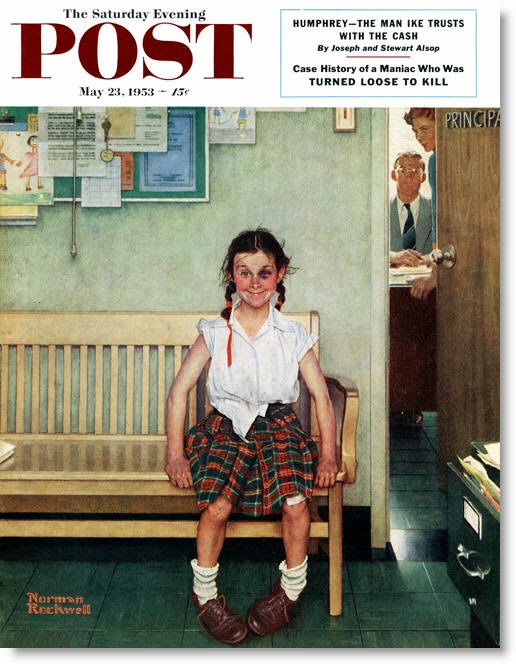
Norman Rockwell and Star Wars

Norman Rockwell (1894-1978) fue un popular ilustrador y pintor americano que a través de sus más de cinco décadas de profesión logró captar como pocos la esencia de la cultura americana. Rockwell se hizo famoso principalmente a través de dibujos que reflejaban la vida cotidiana americana, publicados en las portadas de la revista Saturday Evening Post.


También se destaca su contribución al movimiento Scout a través de los dibujos cedidos a portadas de la publicación Boy´s Life.

En 1943, en plena Segunda Guerra Mundial, Rockwell pintó la serie Las Cuatro Libertades, basada en el discurso del Presidente F.D. Roosevelt en el cual describió los cuatro principios para los Derechos Universales: La Libertad de Expresión, La Libertad de Culto, La Libertad de Vivir sin Miedo y La Libertad de Vivir sin Penuria.


También es renombrada su labor pictórica acerca del problema racial en Estados Unidos. Así, su obra "The Problem We All Live With" trata el problema de la integración racial en las escuelas, mostrando a la niña Ruby Bridges escoltada por agentes federales, mientras camina delante de un muro con pintadas racistas. Este cuadro fue exhibido en la Casa Blanca durante el encuentro que en 2011 mantuvieron la protagonista del cuadro y el Presidente Obama.


Como estamos en un año histórico para los fans de La Guerra de las Galaxias, con el esperado estreno del Episodio VII a finales de año, mi selección personal de Rockwell para 2015 se va a este cuadro. Tras él, la razón por la cual lo he seleccionado. Enjoy it!!!


Sunday, December 7, 2014

Christmas Trees in America

Al día siguiente del Thanksgiving Day, que siempre cae en jueves, el americano se pone manos a la obra de decorar su casa, por dentro y por fuera, con motivos navideños. Por fuera, a mi siempre me han parecido los americanos italianos los más escandalosos. Al menos en lo que se refiere a la iluminación. Tengo un vecino que convida formalmente (enviando una invitación) a todo el barrio el día en que le da al interruptor y su casa y jardín se convierten en un parque de atracción en miniatura. Algunas familias latinas no les andan a los italianos a la zaga, pero en este caso los excesos suelen venir en forma de figuras inflables. Los hay que instalan en el tejado de sus casas muñecos enormes de Santa Claus, con trineo y renos incluidos, todo muy real aunque siempre rayando el exceso. En mi barrio, el exterior con más gusto adornado es el de la casa de mis vecinos Martha y Joe. Detalles relativamente discretos en puerta, ventanas y farol, trineo antiguo de madera apoyado en el porche, y velas iluminadas en cada una de las ventanas. Otro clásico del barrio es el enorme abeto iluminado que tiene mi vecina Joy en el jardín que da a la calle. Su marido, mi amigo George (q.e.p.d.), contrataba una grua todos los años para adornar e iluminar el abeto, y siempre subía a lo más alto del árbol a mis dos hijos con él. Imaginad lo que era para los chicos estar subidos ahí arriba. Cuando George falleció, su esposa decidió dejar la iluminación permanentemente instalada en el abeto, algo que todos los vecinos agradecimos. Cuando llega la Navidad, el abeto siempre nos recuerda a George subido a la grúa, decorando el emblemático árbol.

Una de las liturgias más características de este país es la compra del árbol de navidad, el que todos instalamos dentro de casa. Aquí no se acostumbra a tener árboles artificiales. Uno va a su proveedor local o a un Home Depot y compra un abeto natural. Los hay de varios tamaños, para todo tipo de casas. Nosotros siempre compramos la variedad de abeto azul, por el aspecto tan magnífico que tiene cuando se abren sus ramas y el agradable aroma que desprende en casa.


En mi barrio, los vecinos acostumbran a intercambiar regalos, además de felicitaciones de Navidad. De entre los regalos que recibimos todas las Navidades, dos de los que más aprecio son los que provienen de los Brown (Joy y George) y los Fry (Martha y Joe). Los Brown nos regalan siempre la decoración navideña de la Sociedad Histórica de la Casa Blanca. El motivo de dicha decoración es elegido personalmente por el actual inquilino de la Casa Blanca, y siempre hace referencia a alguna tradición navideña de un presidente que lo haya precedido.


Por su parte, los Fry nos regalan la decoración oficial que emiten el Senado o el Congreso, ya que Martha es guía voluntaria en el Capitolio. El año pasado nos regaló la decoración oficial del Senado, con el escudo de dicha cámara sobre un fondo granate idéntico al color que tenían los asientos de sus señorías en el primer Senado de la República.


Nosotros acostumbramos siempre a viajar por estas fechas y allá por donde pasamos siempre compramos decoraciones tradicionales, una para nosotros y otra para nuestros vecinos más queridos. El abeto azul de casa, además de las tradicionales bolas de navidad, ya cuenta con decoraciones adquiridas en la estatua de La Libertad de Nueva York, en la ciudad histórica de Williamsburg en Virginia, en la Represa Hoover cerca de Las Vegas, en el Gran Cañón del Colorado, en la mítica Ruta 66 a su paso por Arizona, en el Convento de Ephrata o en la patria chica de los Amish del condado de Lancaster, en Pensilvania.


De entre todas las decoraciones que tenemos en nuestro árbol, a mi hay una que me fascina. Es una que adquirimos en 2012 a una escuela de Winchester, en Virginia, que tiene una reproducción de una obra del pintor por excelencia de la Guerra Civil americana, Mort Kunstler. Este artista cedió los derechos de reproducción de su pintura titulada "My friend the Enemy" a una escuela virginiana el año en que se celebraba el 150 aniversario del inicio de la contienda civil. En dicha obra se puede ver un soldado yanqui fumando en pipa tabaco del sur, al lado de un confederado bebiendo café del norte, en un intercambio amistoso en el crudo invierno de 1862.


Este año viajamos a Memphis, en Tennessee. Nuestro destino es Graceland, la casa del Rey del Rock & Roll. Al año que viene, en este mismo blog, hablaré de la que probablemente será la decoración más kitsch de nuestro árbol de Navidad....

Sunday, November 30, 2014

People I like (2)


José Ortega y Gasset (1883-1955). Filósofo y ensayista español, exponente principal de la teoría del perspectivismo y de la razón vital e histórica.


Winston Churchill (1874-1965). Primer Ministro británico (1940-45 y 1951-55) y Premio Nóbel de Literatura (1953).


Luis Eduardo Aute (1943- ). Músico, cantautor, director de cine, actor, escultor, escritor, pintor y poeta español.


Julio Anguita (1941- ). Alcalde de Cordoba (1979-1986) y Diputado de las Cortes Generales de España (1989-2000).


Lawrence Alma-Tadema (1836-1912). Pintor pre-rafaelita holandés, naturalizado británico por la Reina Victoria.

Sunday, November 23, 2014

People I like (1)


Ramón María del Valle-Inclán
Dramaturgo y novelista español, miembro de la Generación del 98.


Margaret Thatcher
Primera Ministra del Reino Unido (1979-1990).

Stephen Stills
Músico americano, integrante de Buffalo Springfield, Crosby, Stills, Nash & Young, y Manassas.

Manuel Azaña
Presidente de la República Española desde 1936 hasta 1939
John Constable
Pintor romántico inglés (1776-1837)

Sunday, November 9, 2014

American Constitutionalism


When in 1767 a modernised British Parliament, committed to the principle of parliamentary sovereignty unlimited and unlimitable, issued a declaration that a parliamentary majority could pass any law it saw fit, it was greeted with an out-cry of horror in the colonies. Such a doctrine, colonists insisted, demolished the essence of all their British ancestors had fought for. In this sense, they objected not only that they were not represented in that Parliament but even more that it recognised no limits whatever to its powers. With this application of the principle of legal limitation of power by higher principles to Parliament itself, the initiave in the further development of the ideal of free government passed to the Americans. They were singularly fortunate, as perhaps no other people has been in a similar situation, in having among their leaders a number of profound students of political philosophy. It was when these colonists discovered that the British constitution, in whose principles they had firmly believed, had little substance and could not be successfully appealed to agains the claims of Parliament, that they concluded that the missing foundation had to be supplied in the form of a new constitution, as they regarded as fundamental doctrine that a constitution was essential to any free government and that a constitution meant limited government. Also, their experience with the colonial charters had also taught them that any constitution that allocated and distributed the different powers necessarily limited the powers of any authority. To the colonists, freedom meant that government should have powers only for such action as was explicitly required by law, so that nobody should possess any arbitrary power. The formula that all power derives from the people referred not so much to the recurrent election of representatives as to the fact that the people, organised as a constitution-making body, had the exclusive right to determine the powers of the representative legislature. The constitution was thus conceived as a protection of the people against all arbitrary action, on the part of the legislative as well as the other branches of government. A constitution which in such manner is to limit government must contain subtantive rules, it must contain general principles which are to govern the acts of the appointed legislature. The idea of such constitution involves not only the idea of hierarchy of authority or power but also that of a hierarchy of rules or laws. A constitutional system involves a subordination of inmediate objectives to long-term ones. This means a limitation of the means available to a temporrary majority for the achievement of particular objectives by general principles laid down by another majority for a long period in advance. This division of authority between a temporary authority and a more comprehensive body implies a recognition of limits to the power of deliberate reason and a preference for reliance on proved principles over ad hoc solutions. To put it differently, a group of men can form a society capable of making laws because they already share common beliefs which make discussion and persuasion possible and to which the articulated rules must conform in order to be accepted as legitimate. From this it follows that no person or body of persons has complete freedom to impose upon the rest whatever laws it likes. A commitment to long-term principles, in fact, gives the people more control over the general nature of the political order than they would possess if its character were to be determined solely by successive decisions of particular issues. A free society certainly needs permanent means of restricting the powers of government, no matter what the particular objective of the moment may be. And the Constitution which the new American nation was to give itself was definitively meant not merely as a regulation of the derivation of power but as a constitution of liberty, a constitution that would protect the individual against all arbitrary coercion.

Based on "The Constitution of Liberty", by F. Hayek.

Friday, November 7, 2014

Princesa

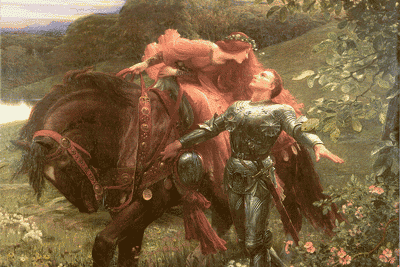
If this was a time of knights and princesses, this would be my princess and her song.


If anyone wants to know
Where to find me
I'll be right here
In the warmth of your arms
'Cause you
You're the one
I can trust in
You've never done me any harm

I'm putting all my troubles
Behind me
I don't feel the same
When I am away from your smile
'Cause you
You're the one that can calm me down
Whenever I get wild

Fooling myself
About how to exist
All by myself
There was much
I had missed
You came and showed me
What happiness is

If anyone wants to know
Where my heart is
Tell everyone
That's it's wrapped around yours
'Cause you
You're the one
I can turn to
You opened up the door...